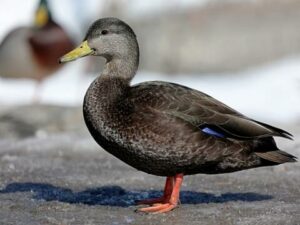
 When one thinks of ducks in eastern North America, the one species t hat usually comes to mind is the American Black Duck. Once the most abundant fresh-water duck in eastern North America, black duck populations began to steadily decline in the 1950s, reaching all-time lows in the 1980s.
The Black Duck Joint Venture (BDJV) was formed in 1989 to help determine population trends and to identify the important factors responsible for this change, with the ultimate goal of ensuring the security of the black duck throughout its range.
Mission of BDJV: The Black Duck Joint Venture’s mission is to promote and to coordinate the gathering of scientific information among Flyway Council, universities and wildlife agencies in Canada and the U.S., that is vital to ensuring sustained populations of Black Ducks and other waterfowl that share their breeding range.
NEW: REQUEST FOR PROPOSALS
FULL ANNOUNCEMENT: www.grants.gov
FUNDING OPPORTUNITY TITLE: BDJV FY08 COMPETITIVE GRANT PROGRAM
FUNDING OPPORTUNITY NUMBER: 122020
SF424 form
DUE DATE: 1 FEBRUARY 2024
 The Black Duck Joint Venture (BDJV) is accepting research proposals to address information needs related to black duck ecology and management.
The BDJV will accept proposals addressing any aspect of black duck ecology and management, but proposals that address priority research needs (see full announcement at www.grants.gov ; search by title “BDJV FY08 Competitive Grant Program” or by funding number “122020”) will have a greater probability of funding.
In addition to the high priority research needs identified in the full announcement, in Fiscal Year 2020 the BDJV is particularly interested in proposals addressing questions about the apparent decline in black duck productivity and projects linking black duck vital rates to habitat features.
The BDJV has limited resources to support scientific research and will award funds to a limited number of applicants based on scientific merit and funding considerations. Award notifications will be announced in April 2024.
The BDJV is a partnership-based conservation program under the North American Waterfowl Management Plan. The mission of the BDJV is to implement and coordinate a cooperative population monitoring, research, and communications program to provide information required to manage black ducks.
- Pass Urine Drug Test: Complete Probation Guide
- Can Synthetic Urine Be Detected? Lab Methods Explained
- Certo Method for Drug Tests: Does It Really Work?
- Best Hair Detox Shampoos for Drug Test: Expert Guide
- The Whizzinator: Critical Flaws You Must Know
- How to Pass Urine Drug Test: Complete Guide
- Monkey Whizz Review: Reliability & Detection Risks
- Clear Choice Incognito Belt: Complete Review & Guide
- Zydot Ultra Clean: Expert Review & Honest Analysis
- Clear THC from Your System: Science-Backed Methods
- Macujo Method Steps: Complete Hair Cleansing Guide
- Old Style Aloe Toxin Rid Shampoo: Expert Review & Guide
- Test Clear Urine Review: Complete Guide & Analysis
- Quick Fix Urine Review: Does It Really Work?
- Best THC Detox Drinks: Expert Guide & Reviews
- Keep Urine Warm for Drug Test: Complete Guide
- Nexxus Aloe Rid Review: Does It Really Work?
- How to Pass a Hair Follicle Test: The Complete Guide
- Toxin Rid Pills: Complete Detox Guide & Expert Review
- Clear Choice Sub Solution: Complete Review & Analysis
For more information about the BDJV or this funding opportunity contact:
Patrick Devers
Science Coordinator, BDJV
U.S. Fish and Wildlife Service
11410 American Holly Drive
